Mindset Frameworks: Why Being "Right" Is Holding You Back (from Derek Sivers)
Truth is a distraction. Learn how to choose beliefs based entirely on the actions they create.
In today's episode of The Social Chameleon Show, I bring you a fresh take on old beliefs featuring an in-depth look at Useful Not True by Derek Sivers. This episode is not about obsessing over what is absolutely right or wrong. Instead, we challenge the idea that truth is the most important metric when building your beliefs and making decisions.
You will hear why it is more practical to ask if a belief moves you forward rather than asking if it is true. Through real-world examples and strategic reframing, Derek Sivers shows how you can choose beliefs based entirely on their usefulness, not just their accuracy. If you are tired of getting stuck in endless debates or feeling paralyzed by doubt, this conversation will force you to look at your thoughts in a new light.
Expect to learn how to reframe past experiences, make peace with old stories, and find perspectives that unlock action. I will give you simple challenges and actionable questions to remind you that being "right" takes a back seat to being effective.
If you are ready to shake up your thinking, focus on what helps you grow, and become truly legendary, this episode will get you off the sidelines and into motion.
Enjoy the episode!
🎓 Lessons Learned
- Truth Is Subjective
- "Truth" depends on perspective and context—not everything people say is an absolute fact.
- Beliefs Drive Action
- Your beliefs shape emotions, which then drive your actions. Choose beliefs that help you move forward.
- Reframe Situations
- Shift your viewpoint to see things in new, more empowering ways, rather than feeling stuck.
- Rules Are Negotiable
- Rules and obligations are created by people and can be questioned, changed, or adapted if they're not useful.
- Memories Aren’t Facts
- Memories feel real but are often inaccurate. Be open to re-examining your past from new angles.
- Culture Shapes Meaning
- Norms, manners, and meanings are cultural and personal, not universally true or fixed.
- Almost Nothing Is Certain
- The past and future are interpretations or predictions, not concrete facts you should base everything on.
- Useful Over True
- Focus on what belief or perspective helps you most now, rather than what’s perfectly true.
- Choose Empowering Perspectives
- Actively select beliefs or mindsets that get you unstuck, motivated, or more at peace with your life.
- Actions Define You
- You become who you act like; pretend to be who you need, and your actions shape your reality.

Derek Sivers
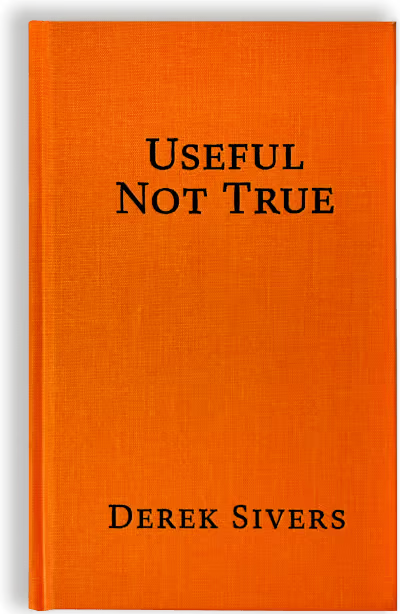
Useful Not True
In Useful Not True, Derek Sivers argues that we obsess over finding what is objectively true when we should focus on what is practically useful. He defines "true" strictly as a concrete fact that is always true for everyone, everywhere. Everything else is just a perspective. The book is a manual for outsmarting your own instincts, structured in five steps: recognizing that almost nothing people say is true, accepting your own thoughts are not true, understanding ideas are tools, finding better perspectives, and adopting what works for you now. Instead of seeking to be right, Sivers challenges you to choose beliefs based entirely on the actions they create.
Key Insights:
- Beliefs create emotions, and emotions create actions. You must choose a belief specifically for the action it creates.
- True is the enemy of useful. Just as perfect is the enemy of good, demanding that a philosophy or idea be perfectly "true" prevents you from utilizing its benefits.
- Your first thought is an obstacle. Your instinct will jump to a conclusion, but your wisdom must override it. You have to get past your first reaction to find a better perspective.
- You are the strange one. The beliefs you hold as undeniable truths are viewed as silly myths by someone else. To change, you must see yourself from the outside.
Weekly Challenge Trophy Legendary Weekly Challenge
Outsmart Your Own Brain
Step 1: Catch your first thought. Identify one belief holding you back right now. Your brain will insist it is a concrete fact. It is not.
Step 2: Strip away the truth. Stop asking if that belief is accurate. Look at the result. Ask yourself what action this belief creates. If it makes you hesitate or freeze, it is a useless tool. Discard it immediately.
Step 3: Choose your perspective. Select a new belief based entirely on the action it creates. If your old belief was that you are too late to start, your new perspective is that waiting gave you the ultimate advantage to learn from the mistakes of others. You are not lying to yourself. You are picking a better tool.
If it gets you out of bed and executing, it is the right perspective. Take the first step immediately to build momentum. This is simple, not easy.
SELECTED LINKS FROM THE EPISODE
Derek’s Books
On The Time Ferris Show
Derek Sivers, Philosopher-Entrepreneur — The Greatest Year of His Life (#777)
Derek Sivers on Developing Confidence, Finding Happiness, and Saying No to Millions (#125)
Episode Transcriptions
Show notes and transcripts powered with the help of Castmagic. Episode Transcriptions Unedited, Auto-Generated.
Tyson Gaylord [00:00:05]:
Welcome to the Social Chameleon Show, where it's my goal to help you learn, grow, and transform on your path to becoming legendary. Today we're doing something different. I recently, recently rewatched Derek Sivers' updated version of Useful Not True, and I was blown away the first time I read it. And but that was a few years ago. I think it was 2024. This initially came out. And it's always nice to go back and to reread works, and especially things you find meaningful and powerful. You're always a different person when you go back because you're not the same person when you read it, so you can pick up different things and whatnot.
Tyson Gaylord [00:00:38]:
And so the second time around, I was watching it and I was— and something spoke to me, and I was like, I need to reach out to Derek. And I did, and he absolutely gave me the absolute greatest honor of allowing me to republish his reading of Useful Not True. If you don't know Derek, he is one of the most dangerous thinkers alive because he simplifies things we complicate. He founded CD Baby, sold it for $22 million, and donated the proceeds. He does not play by the standard rules of success. His newest concept challenges our addiction to being right. We spend our lives arguing about what is true. We treat our morals, advice, and social norms as concrete facts.
Tyson Gaylord [00:01:22]:
Derek argues that truth is a distraction. The better question is, is this useful? He points out a straightforward practical equation: beliefs create emotions, emotions create actions. Does your current belief help you move forward or does it keep you stuck? If a belief paralyzes you, discard it. If a belief empowers you, keep it. You do not need absolute proof. The message is punchy and may challenge your need for certainty. Good, that means it's working. Ask yourself, are you trying to be right or are you trying to be legendary? So I'm going to play the, the video version of this audiobook.
Tyson Gaylord [00:02:02]:
Um, for those just listening, you're not really missing anything. There's just captions and whatnot on it. You're missing Derek's lovely face and the time he spent doing the video. However, the message is still the same. It's, it's, it's an audiobook with a video version., as this podcast is both video and audio, it will be on YouTube and Spotify and our Substack, and also any play— podcast players that do support the video version, it'll be available there for you on your podcast player. And without further ado, let's hear Derek Sivers reading Useful Not True.
Derek Sivers [00:02:33]:
What's this about? This book is about reframing, changing how you think about something and choosing a perspective that's useful to you right now. Whether or not it's universally true. Before we begin, I need to sharpen that word "true." In this book, when I say "true," I mean absolutely, necessarily, objectively true. It's not only in the mind. Any creature or machine could observe it and agree. It's a concrete fact, always, everywhere, and for everyone. There's no other way to see it. That's what I mean by true.
Derek Sivers [00:03:21]:
This narrow definition is important because whatever you consider true is closed, no questioning. But when you say not necessarily true, it opens it up for reconsideration. Notice that not true does not mean false. It just means not necessarily objectively absolutely true for everyone everywhere always. It doesn't mean you're wrong. It means there could be another possibility or perspective. Let's look at useful not true in 5 steps. 1.
Derek Sivers [00:04:06]:
Almost nothing people say is true. 2. Your thoughts aren't true. 3. Ideas can be useful, not true. 4. Reframe—find better perspectives. 5.
Derek Sivers [00:04:26]:
Adopt what works for you now. What time is it? What time is it right now? For who? You? For most people in the world, that's not the current time. What day is it today? For who? You? I'm in New Zealand, so it's Saturday. For my friends in America, it's Friday. In Fiji, I went to the island of Taveuni. That's where the International Date Line crosses. There's a sign and a line on the ground. You can step back and forth across it.
Derek Sivers [00:05:01]:
Left foot Sunday, right foot Monday. It reminds you that dates are subjective, but your feet are in the sand, and that's true. When does summer begin? For who? You? For half the planet, Christmas is summer and July is winter. This is a silly but important reminder. People speak as as if they're stating facts. They say things like, "You can't do that," and "Here's what women want," but it's just their current perspective. It's their metaphorical time zone, which is probably different from yours. They're not wrong.
Derek Sivers [00:05:46]:
It's just not the only answer. Perspectives feel real. A kid says a cat is a pet. A mouse says a cat is a threat. They can't see it any other way. Their friends agree, which solidifies their view, making it feel totally true. This house is overpriced. Nothing matters more than family.
Derek Sivers [00:06:13]:
You're talking too much. To the person speaking, These feel like facts, not opinions. They really think that house is overpriced and you're talking too much. But someone is happy to buy that house at that price, and someone wants you to talk more, so their statements are not necessarily true. Someone says, "That behavior is immoral and wrong." But from another perspective, that behavior is moral and right. So essentially, the person is just saying, "I don't like it." Every statement everyone says could be prefaced with this disclaimer: "From my limited point of view, based only on what I've experienced..." But they don't need to say that. Instead, we need to know that and hear it that way. No matter how much authority or conviction they have, no matter how respected or famous they are, Their statements are just one biased point of view.
Derek Sivers [00:07:25]:
No picture is the whole picture. They say the camera never lies, but of course it does. Someone shows you photos of happy people laughing. They say this is proof that people are doing well. Someone else shows you photos of people looking sad. They say this is proof that people are miserable. Ironically, all the photos were taken at the same place and the same time, but one camera focused on the happiness while the other focused on the misery. Both claim that their photos show the truth, but it's just one perspective.
Derek Sivers [00:08:07]:
People find facts to support their argument on any debatable topic or view of the world. Facts can be true, while the perspective is not. No picture is the whole picture. It's just one of many possible angles. People share perspectives, not facts. People communicate for social and emotional reasons. Notice the word "commune" in "communicate." Socially, they want to bond. Judgments, gossip, ethics, and opinions are all great for signaling and connecting.
Derek Sivers [00:08:55]:
Emotionally, they want validation. They want others to acknowledge and agree that their viewpoint is justified. When you can see someone's point of view It tells them that you're standing on their side. That's why people rarely share objective, unbiased facts. Actual facts are as boring as dirt. Nobody bonds over facts. They have more incentive to share their thoughts, which are never necessarily true. Separate events and interpretation.
Derek Sivers [00:09:41]:
A young man in a hooded sweatshirt knocks at your door, hiding his face, looking nervously around. Hey, hey, yeah, uh, uh, can I come in? I, uh, need a glass of water. You say no and don't let him in. A well-dressed old lady knocks at your door. I'm so sorry, my dear, but I was walking home and started feeling faint. Could I trouble you for a glass of water? You say, yes, of course, let her in and get her a glass of water. After she thanks you and leaves, you notice your wallet is gone. Language can be sneaky like this.
Derek Sivers [00:10:19]:
Some statements are clearly suspicious, so you don't let them pass. Others sound trustworthy, so you let them in with your defenses down. But their hidden judgments will steal your clarity if you don't stop them at the door. Your friend says, "My mother abandoned me." Stop. Get the actual facts. Turns out his mother had two full-time jobs, so he was raised by his grandmother in the same town and stayed with his mother on weekends. So he's really saying, that he felt abandoned. It helps both of you distinguish between the facts and the feelings.
Derek Sivers [00:11:00]:
Another friend says someone is needy, stubborn, and inappropriate, as if those are traits. But the person judging is usually just expressing their unmet expectations. So the statement tells you more about the accuser and almost nothing about the accused. Imagine the job of a police clerk filing an incident report by listening to all the emotionally charged accusations to record the few unbiased observable events. Feelings matter. To address them, we have to distinguish them. Get the dry facts with no interpretation. What's left are the feelings and the meanings.
Derek Sivers [00:11:48]:
We can't change what happened, but we can change the meaning we give it, which changes how we feel about it. Bridge Guard. A group of adventurers needed to cross the narrow bridge over the deadly canyon, but a huge threatening guard, like the genie from Aladdin's lamp, blocked the entrance. He said in a booming voice, "No one can cross until you tell me what's true." He snapped his fingers, and everyone's vision was replaced with a scene. The king, presented with a bowl of soup, took a sip, then pushed it away with a scowl, saying, "It's too salty." Then their vision returned. An adventurer said, "The king doesn't like the soup." The guard boomed, "No." "He thinks it's too salty." "No." Then one said, "He said the words 'it's too salty.'" "True." That one person was allowed to cross the bridge. Then, blocking again, "No one can cross until you tell me what's too salty." No. He snapped his fingers and they saw a new scene.
Derek Sivers [00:13:13]:
A woman is trapped in a box and can't get out. She's pushing, pounding, and trying everything, but nothing is working. Then their vision returned. She's trapped in a box and can't get out? No. She's trying everything, but nothing is working? No. Then one said, She's pushing and pounding the box. True! That one person was allowed to cross the bridge. Then, blocking again, no one can cross until— But the youngest girl in the group figured it out.
Derek Sivers [00:13:53]:
She walked right up to the fearsome bridge guard and said, I'm going to cross now. Then she squeezed past his legs and crossed the bridge. So the rest did the same. The guard smiled with pride. Rules are a starting point, not the final answer. Kids make up rules for games. Got you! No, I was still touching the base, remember? Well, I've got the talisman in my pocket, so that doesn't count. Fine, but from now on you can only use that once per game.
Derek Sivers [00:14:31]:
"Okay, but no tag backs for 5 seconds." Instead of playing by the rules, they're playing with the rules, playing with the game itself. Changing the game is part of the fun. We can still do this. Rules set expectations and the terms of the game. They're a useful starting point, but they're not the final answer. Governments and businesses make rules, but those rules are as random as children's games created by a similar process. A few people in an office, tired and wanting to break for lunch, agreed on something and haven't thought of it since. An assistant typed it into an official document.
Derek Sivers [00:15:14]:
The person enforcing it just learned about it last week and doesn't really care but doesn't want to get in trouble. They treat these rules as true because it makes their job easier, but they're negotiable. Rules can be ignored sometimes if a rule's purpose is understood and respected and the greater good is not harmed. It's irrational and immoral to follow that rule. My friend was part of a student protest in Chicago 35 years ago when he was 18 and was arrested for a few hours. 30 years later, he and his wife went for a vacation in Australia. Upon arrival, the visa forms ask if you've ever been arrested. He ticked yes.
Derek Sivers [00:16:07]:
The border control guy at the airport wouldn't let him in the country and sent them back on the next flight to Chicago. They were devastated. Thousands of dollars lost, vacation ruined. Before they left, the officer said, "Next time, make it easier for everyone. Just tick 'no.'" Rules can be changed. Society doesn't want rules to change since most people don't want the trouble. But improving the rules over time is necessary. Someone has to do it.
Derek Sivers [00:16:44]:
When the founding fathers of the United States of America were drafting the Constitution, it was assumed that this new country would have 3, 6, or 12 presidents. When someone proposed having only one president, most delegates were against it since they had just left a kingdom and wanted nothing like a king. The issue was debated for weeks before finally agreeing by a 7-3 vote to have just one president. It's a reminder that the way things are is arbitrary and not the only way. The world is as negotiable as a flea market in Marrakesh. Only a fool doesn't haggle. Obligations are not true. Family, friends, colleagues, and communities put social pressure on you to do what they want you to do.
Derek Sivers [00:17:49]:
They say it's your obligation or your duty, but those terms are social expectations. They're not real. They're not even universal. They're just one way to see the situation. The people saying it's your obligation really just want you to do something, but instead of saying, "I want," they blame a higher legitimacy. It's manipulative. They say their wishes are laws you must obey. But if they didn't personally want you to do it, they would have said, "Nah, don't worry about it." Some people say that their feelings are your problem.
Derek Sivers [00:18:31]:
But that's ridiculous. You can't control people's feelings. They are able to choose their response. The word responsible comes from response-able. Everyone has their own problems. To know whose problem it is, think who benefits the most from solving it. The boss says you need to work late, but that indicates a flaw in the company's system. Which is their problem, not yours.
Derek Sivers [00:19:01]:
Maybe working late would ultimately harm the company by keeping them from finding a more sustainable solution. Parents say, "You need to take care of us when we're old." But maybe we all need to prepare for our own future care instead of burdening others with it. They might say you're a bad person for not doing what they want you to do. But that's not true. Maybe they're just disappointed that you're not taking their wish as your command. Cultural Meanings. One of my best friends from Singapore was visiting me here in New Zealand last summer. She and I were upstairs when a local friend of mine came by and yelled from downstairs, "Yo, Dee!" I yelled down, we're upstairs.
Derek Sivers [00:19:55]:
He let himself in, helped himself to a drink in the fridge, came up barefoot and sweaty, and laid down on the floor. My Singaporean friend told me later this was really confusing since the way this guy and I were acting towards each other was so rude. In her culture, all guests are treated with hospitality, but to me that would feel off-putting Treating a dear friend like a formal acquaintance? To me, casual familiarity is the most endearing. Mikasa sukasu. Actions have no inherent meaning. To yell "Come in!" instead of answering the door can be offensive to one person and endearing to another. When someone tells you what something means, it's never true, because it's not the only answer. It's just one perspective.
Derek Sivers [00:20:52]:
You might do something you think is polite only to have someone tell you it's rude. A British woman moved to China and lived with a Chinese family for a year. She ate dinner with her host family every night and became conversationally fluent in Mandarin. One night, after she asked, "Could you please pass the salt?" Her host mother scolded her, saying, "You're being rude!" The British woman was confused and said, "I'm sorry, I said please." The mother said, "Listen to us. We're family. When we want salt, we just say 'salt.' You're part of our family too. Using formal manners here in our home is rude because it treats us like strangers." Manners, norms, and meanings are never true. This is important to remember when people tell you this is good, that is bad, this means that, etc.
Derek Sivers [00:22:00]:
Try to find their incentives. Middle of the night, you're fast asleep. You hear a loud bang downstairs. Your body kicks into emergency danger mode. Eventually you find out that your cat knocked over the broom. Mystery solved. Back to sleep. You're trying to enjoy a quiet day at the park, but this annoying little girl won't stop screaming.
Derek Sivers [00:22:25]:
You leave the park angry at a stranger. On your way out, you see the girl has been screaming in pain because she fell out of a tree and her leg is clearly broken. Your anger is replaced with sympathy. These two stories are similar. When something is confusing, alarming, or unexplained, we assume the worst. But once it's explained, we relax. When we don't understand someone, they feel like an outsider, maybe subconsciously an enemy. It's primal and tribal to feel defensive.
Derek Sivers [00:23:03]:
Our ancestors had reason to be wary and survived by being suspicious. But once we learn the reason, cause, or origin of someone's behavior or belief, we can start to feel empathy and connection. When someone believes something that seems crazy to you, consider what incentives from their point of view make that belief useful. It helps you understand someone and helps you feel less defensive. It helps you separate the person and the actions, to see their beliefs not as who they are, but as something they're currently holding for a purpose. The brain invents explanations. Some people have damaged fibers connecting the left and right hemispheres of the brain and need to have that connection surgically severed. They live pretty normal lives even though the two sides of their brain are disconnected.
Derek Sivers [00:24:09]:
Psychologists work with these people to better understand the brain. They showed a patient a message to her right eye saying, please close the window. She got up and closed the window. Then they showed a question to her left eye: Why did you close the window? She said she chose to do it because she was cold. To another patient, a researcher said to only one ear: Please walk. The patient started walking. Then they asked his other ear: Why did you walk? He said he just felt like getting a drink. One woman being tested for seizures had electrodes implanted in her brain.
Derek Sivers [00:24:53]:
When they stimulated one area, she started laughing hysterically. The doctors asked why. She said, "The picture on the wall is really funny." Later, when probing that same area again while she was eating, she started laughing again. This time she said it's because her fork is really funny. These people weren't lying. They fully believed those were the real reasons. This isn't just brain patients. It's an insight into the human condition, something that everyone does all the time, but these tests were able to show.
Derek Sivers [00:25:34]:
When asked for an explanation, the brain invents a reason and completely believes it. To that person, the explanation feels like absolute fact, the kind they swear is true, believe deeply in their core, and will fight to defend. Think of the implications. Major life choices, attraction, excitement, love, jealousy, revenge, anxiety, fear, and interpersonal conflict—all of these are supported and defended by explanations that aren't true. People's motives are unknowable even to themselves. Let go of the need for a reason. Ignore their explanations. The only true facts are their actions.
Derek Sivers [00:26:32]:
Memories are not accurate. January 28, 1986, at 11:39 AM, the space shuttle exploded during liftoff, killing all 7 crew members. It was a big deal. As soon as it happened, everyone stopped what they were doing to watch the TV updates. Because it was a school day in America, a psychology professor handed out a questionnaire to his freshman students asking what they had been doing moments earlier when they had first heard the news. Where were you? Who were you with? What were you doing? Then he saved their answers for 3 years for the sake of what came next. 3 years later, he gave those same students the same questionnaire, asking what they had been doing when the space shuttle exploded. After they answered, he asked how confident they were in their answers.
Derek Sivers [00:27:27]:
Almost all of them said 100%. Then he showed them their original answers from the day it happened. Nobody remembered correctly. Their answers were all different. Everybody had misremembered their own facts. Memories feel like facts, but they're not. People don't doubt their memory, but you should. The past is not true.
Derek Sivers [00:28:04]:
When I was 17, I was driving recklessly and crashed into an oncoming car. I found out that I broke the other driver's spine and she'll never walk again. I carried that burden with me everywhere, and I felt so horrible about it for so many years that at age 35, I decided to find this woman to apologize. I found her name and address, went to her house, knocked on the door, and a middle-aged woman answered. As soon as I said, I'm the teenager that hit your car 18 years ago and broke your spine, I started sobbing, a big ugly cry surfacing years of regret. She was so sweet and hugged me, saying, oh sweetie, sweetie, don't worry, I'm fine. Then she walked me into her living room. Walked.
Derek Sivers [00:28:50]:
Turns out I had misunderstood. Yes, she fractured a couple vertebrae, but it never stopped her from walking. She said that little accident helped her pay more attention to her fitness and since then has been taking better care of her health. Then she apologized for causing the accident in the first place. Apologized? I said, well, no, it was my fault for ignoring the yield sign. And she said, "No, it was my fault because I was eating while driving and not watching the road. You didn't hit me, I hit you." Seems we had both thought the accident was our fault and had spent 18 years feeling bad about it. This time she started crying, saying, "It's so stupid, these stories." Aim a laser pointer at the moon.
Derek Sivers [00:29:43]:
Then move your hand the tiniest bit, and it'll move 1,000 miles at the other end. The tiniest misunderstanding long ago, amplified through time, leads to giant misunderstandings in the present. We think of the past like it's a physical fact, like it's real, but we never have all the information, only interpretation. One story based on one point of view. That's what we call the past. Wanna bet? By definition, the future doesn't exist. It's what we call predictions in our imagination. People think that the more vivid the image is in their mind, the more likely it's real.
Derek Sivers [00:30:35]:
They say, "I'm sure it's going to happen. I can feel it. I can picture it now." People are so certain about their predictions. "This meeting is going to be so boring." "More funding will help." "Yeah, if that guy gets elected, it'll be a disaster." "I'd be happier with a bigger house." None of these statements are true because nobody knows the future. We can't even predict our own reactions. Winning the lottery or having an accident might be surprisingly bad or good. Even a statement as simple as, "I need to relax," might not be true since it's a prediction that relaxing will help. The problem is certainty and not realizing it's a prediction.
Derek Sivers [00:31:28]:
Try asking, "how much do you want to bet?" or maybe "how confident are you about that prediction, from 0 to 100%?" Instead of black or white, right or wrong, it will probably be degrees like "80% sure." When they realize their confidence is less than 100%, they can consider other possibilities. Even science isn't true. When I started writing this book, my friend asked me for an example of what I consider to be true. I said, science. He's a scientist, so he got a good long laugh and said, no, no, no, science is useful but not true. Then he explained, in the scientific process, nothing is final or complete. No model is true. Each one just aims to be less and less wrong.
Derek Sivers [00:32:27]:
Every conclusion is an invitation to improve it. Scientists learn about existing findings, question them, and try to supersede them. It's better to be curious than correct. It's intellectual humility. Newton's laws of motion from the 1600s work for most situations. Then Albert Einstein developed the theory of relativity, which showed that Newton's laws aren't sufficient. Then quantum mechanics showed limitations in Einstein's theory. But yet, to land on the moon or launch a satellite into orbit, we still use Newton's laws, since they're simple and good enough for that purpose.
Derek Sivers [00:33:09]:
The most accurate theory is not always the most useful. And a rule of thumb can be far from true, but good enough to get you where you need to go. Fake or real? True or false? So what? People have always made up nonsense and made others believe it. That's nothing new. But now computers create text that sounds human and video that looks real. Cultures of the world have always had conflicting values, but they used to be isolated. Everyone around you agreed on what's right and wrong and how to live. But now everyone is connected, so these clashing values are confusing or enraging.
Derek Sivers [00:33:58]:
It helps to see almost nothing as necessarily true. Saying "so what" sounds dismissive, but it's asking an important question: so what are you going to do about it? You see a video of an important person saying something shocking. Is it taken out of context? Is it fake and actually generated by a computer? You argue with someone who has different beliefs. They say your values are harmful and wrong. The news is reporting something upsetting. Is it falsified propaganda or misrepresentation? If it's true, what would you do? If it's false, what would you do? Consider both scenarios and figure out your response. You might never know the absolute truth, so what matters are your actions. If belief or doubt makes you do something good, then choose that view because it's useful to you.
Derek Sivers [00:35:07]:
If you'll do nothing either way, then never mind. Bridge Guard Revisited. I want to make sure the point of the bridge guard story came across. The king said, "It's too salty." Did he actually think it's too salty? Who knows? Maybe he doesn't want to admit that he's tired or sick. Maybe he's testing the chef's confidence. Just because someone says something doesn't mean it's true. The woman in the box is pushing and pounding. But we shouldn't jump to the conclusion that she's trapped can't get out, trying everything, and nothing is working.
Derek Sivers [00:36:00]:
That's the kind of self-defeating belief we're surrounded with in everyday life. The girl put these two examples together and got the message that the guard isn't actually blocking the bridge. Just because he says no one can cross doesn't mean it's true. That's what this part of the book was about. Distrust limitations. Strip away interpretations to see the few actual facts. We're held back not by raw facts, but by the meanings we give them. That was about you, not them.
Derek Sivers [00:36:48]:
All of the chapters until now have been about other people. It's so easy to see their faults, so full of nonsense, thinking they're so right with their weird beliefs. It's much harder to find fault in yourself. Only after I see mistakes in others do I realize that I make those same mistakes. That's why I put the chapters in this order. First, I pointed at other people so you could clearly see their faulty thinking. Now let's remember that you make those same mistakes. Almost nothing you say is true.
Derek Sivers [00:37:30]:
You focus on one angle of the whole picture. Your brain makes up explanations. Your perspective feels like a fact. Your certain future is just a prediction. Your thoughts are theories open for improvement. Consider what incentives make your beliefs useful. This book, from start to finish, is entirely about you. Maybe you're full of nonsense, thinking you're so right, thinking your beliefs are actually true.
Derek Sivers [00:38:13]:
You are the strange one. A traveler comes to a river and sees a local woman on the opposite bank. He yells across, "How do I get to the other side of the river?" She yells back, "You are on the other side of the river!" An American woman went on a vacation to Scotland. Talking with a group of people there, she said, I just love your accent. They said, we don't have an accent, you do. For hundreds of years, people worshiped Zeus, Athena, Odin, and Thor. Now we call it mythology. But when it comes to our own beliefs, no, no, no, no, no, those are just true.
Derek Sivers [00:38:59]:
Only others' beliefs are myths and superstitions. You take some principles or values very seriously. You think of them as undeniable truths, but to other people, you are the one with silly beliefs. See yourself from the other side of the river. You have an accent. Since you know other people's beliefs aren't true, you have to realize that yours are also not true. You can't trust your mind. There was a crime out on Park Avenue today, so the police are gathering information.
Derek Sivers [00:39:44]:
A helpful witness said, yeah, he had a red mustache, green eyes, and a scar by his right ear. He was 6 foot 1 and had a tattoo of a dragon on his right shoulder. The police said, this is great information. How sure are you of this? The witness said, "I'm completely sure, 100% positive. I mean, I didn't see it firsthand because I was inside the back room with no windows, but I think I heard someone whispering something like this." That's your brain in the dark inside your skull. It can't see or hear or experience anything directly. It interprets little signals sent through nerves, which is not much information to work with, so it's often mistaken. But it tells you it's completely sure, 100% positive.
Derek Sivers [00:40:41]:
The movies that scare me the most are the ones where the hero realizes he can't trust his own mind. Vanilla Sky, Memento, Beautiful Mind, Jacob's Ladder, The Others, Fight Club. The Sixth Sense and The Matrix. It's terrifying to find out you're crazy. What you thought was real is not. But if you can't trust your mind, what can you do? In each of these movies, the hero gets through it for the better. When he finds out his mind has been tricking him, it's upsetting, but he adapts. His mind was at odds with reality, but can now see the difference.
Derek Sivers [00:41:27]:
It's even a relief because it explains some frustrating moments of confusion in his past. Since old beliefs were disproven, the hero takes in reality with clear eyes. He carefully proceeds with less confidence and more humility. So can you re-edit your mind's movies. The movie 500 Days of Summer is a beautiful example of doubting your past. We see many scenes of a boy and a girl happily in love, but always from his point of view. Then suddenly the girl says, I think we should stop seeing each other. The boy is shocked and confused and sinks into depression because he's convinced that she's his true love and doesn't understand why why she would break up since they were so happy.
Derek Sivers [00:42:22]:
Eventually his little sister says, I think you're just remembering the good stuff. Next time you look back, you should look again. Then the movie does something wonderful. It replays those same scenes it showed before, but now with a different edit. Before, we saw her smile at him. But now the camera watches longer and we see her smile was fake, lasting only a second. Now we see they had many fights. Before we saw them holding hands, but now we see he tried to hold her hand and she refused it, pulling away.
Derek Sivers [00:43:01]:
Now we see that she never loved him. The signs were there all along. He had been focusing only on the happy memories ignoring the rest. When he focuses on the bad memories, her breakup is not confusing or even painful. This perspective helps him make peace with the past and move on. Consider this cinematic approach for the memories that haunt you. For example, almost everyone says they were unpopular in school, that they were bullied and teased. They form their self-identity around that story.
Derek Sivers [00:43:43]:
People make fun of me. I'm not one of those likable popular types. It's probably not true. It's probably a misinterpretation, not realizing that happened to everyone. Next time you look back, look again. Replay your past from different angles until you find the lesson or closure you need. Hanging inherited paintings. My mom inherited an ugly painting from her mom.
Derek Sivers [00:44:19]:
It hung in the living room and visitors would comment on how it felt wrong, but she kept it there for sentimental reasons. One day, when she took it out to be reframed, they found the artist's signature and date written underneath the old frame. Turns out the painting had been hanging upside down the whole time. Turned right side up, it looked much better. Kind of like beliefs. We inherit pictures of how to think and act and tend to keep them as is, even if they're problematic. Your mother always said, be careful, teaching you to live in fear. Your father had a terrible temper, teaching you to not share your thoughts.
Derek Sivers [00:45:06]:
Your first major breakup taught you that you don't deserve love. This is the interior design of your mind, your internal environment. Take these paintings out under a bright light to be reframed. When you remove the frame and flip them upside down, you you can make sure they're hanging the right way. Or decide to throw them away. Make-believe. Kids scream, "Monster in the hallway!" and hide behind the couch. They stack up cushions for protection and plan their defense.
Derek Sivers [00:45:47]:
They know there's not really a monster in the hallway, but it's exciting to feel the adrenaline of panic, to make a shelter and feel safe. One kid yells, "The floor is hot lava!" Leaping between furniture is a fun challenge. One slips and wails, "Help! I'm falling! Save me! Save me!" Now one kid can feel protected while the other gets to be the rescuing hero. Mom calls, "Pancakes are ready!" and all stories stop when the kids run into the kitchen. Kids believe anything fun for a while. It's called make-believe because they're making up beliefs. The game has a purpose. Each belief gives them a new situation and lets them adopt a new role, like protector or inventor.
Derek Sivers [00:46:42]:
Grown-ups have their own version of make-believe. Everything happens for a reason. Those people are evil. I would be creatively prolific if I could quit my job. None of these statements are true, but we like the way it feels to believe. Beliefs have a purpose. They help us adopt a perspective or identity. They help us take action or cooperate with others.
Derek Sivers [00:47:13]:
The only problem is when we confuse belief with reality and insist that something is absolutely true because we believe it. Beliefs don't exist outside the mind. Have you ever seen one in nature? All beliefs are make-believe. Beliefs are not facts. Whenever someone says "I believe," then whatever they say next is not true. If it was a fact, there would be no need to declare a belief. You don't say "I believe in squirrels." You don't say "I believe squares have 4 sides." It's just a fact, so there's no need to take a stance. You say "I believe" when it's not a fact that everyone can see.
Derek Sivers [00:48:10]:
Since people view it differently, you share your perspective on how you see it. A belief is something you think is true without proof. A fact is an objective reality, something proven true, verified with conclusive evidence. No beliefs are true. If a belief was proven true, it would no longer be a belief. Galileo believed the planets orbit around the sun, but he didn't have proof. Hundreds of years later, when it was proven true, it ceased to be a belief and became a fact. But in his lifetime, it was just a belief.
Derek Sivers [00:48:55]:
So beliefs are a stance on what's inconclusive. You have to say, I believe Because it's not the only answer. It's not a fact. Not yet. The more emotional the belief, the less likely it's true. Some beliefs are basically facts but without absolute proof. Tomatoes are a vegetable. Tonight's movie starts at 7.
Derek Sivers [00:49:28]:
Then my friend shows me proof that tomatoes are a fruit and the movie starts at 8. Cool! I'm glad to be corrected. Some beliefs make people really emotional. Think of one of your particularly strong beliefs. If someone showed you absolute proof that your belief is wrong, would you be glad to be corrected? Would you instantly change your mind? Why not? Maybe you see that belief as a part of who you are. Would changing it change your public persona, your self-identity? Some people, when challenged on their beliefs, get all upset and scream, "But I believe this deeply in my heart of hearts!" Wow, look at all that emotion. It must actually be true. Yeah, right.
Derek Sivers [00:50:23]:
As if the amount of emotion measures the truth of the belief. Maybe it measures the opposite. If it was absolutely objectively true, there would be no need to get upset. You could just point to the conclusive proof. That's that. Instead, you might be using that word believe to mean My identity depends on this. Especially if you feel the need to tell everyone your beliefs. Your first thought is an obstacle.
Derek Sivers [00:51:07]:
Here's a common optical illusion: two horizontal lines the same length. The top one has diagonal lines going out from its edges. The bottom one has diagonal lines going in from its edges. Your instincts insist that the top line is obviously longer, but if you measure them to confirm, you'll prove to yourself they are actually the same. So your wisdom has to go against your instincts and remind yourself that they are actually the same, even though it feels wrong. You override your instincts with wisdom. Your instinct says somebody wronged you. Your wisdom reminds you that they could say the same about you.
Derek Sivers [00:51:56]:
Your instinct says your current situation is horrible and hopeless. Your wisdom reminds you that you can use any situation to your advantage. Your instinct says you know right from wrong. Your wisdom reminds you that your norms are one of many valid perspectives. Your first thought is an obstacle. You need to get past it, outsmart it. Your instinct never goes away, but let your wisdom have the final say. Fill your senses with reality.
Derek Sivers [00:52:41]:
When I'm feeling troubled, it helps to look around at reality. Am I in physical danger? No, I'm in a room. I'm safe. It's a reminder that the trouble is in my head. So I get away from all people and media to avoid all viewpoints, opinions, and drama. I shut off my devices. I go to a place where the natural world is untouched by humans, ideally deep into nature, and stay a few days. But a beach or a forest for an hour will do.
Derek Sivers [00:53:16]:
I fill my senses with reality— wind blowing, waves crashing, plants and animals doing their thing. This place was about the same a million years ago and a million years from now when people are gone. Nature carries on. Humans are just another chattering species, making noise like birds and dogs. Almost nothing people say is true. My thoughts aren't true. Norms, obligations, the past, the future, and fears—none of it is real. They're just thoughts formed into stories.
Derek Sivers [00:53:57]:
Out here, they don't exist. I find this a better starting place for reframing. Bowling. Curve into the target. I'm pretty bad at bowling and frisbee. I roll the ball or throw the disc straight at the target. But away it curves. After this happens a few times, I adjust.
Derek Sivers [00:54:27]:
I stop aiming straight since that's not working. If it always curves to the left, I aim to the right. It feels wrong to aim away from the target, but it curves back to the center. It works. Same with thoughts. I try to think straight, But sometimes my thoughts lean to one side. When my mind is missing the target, I aim it the other direction to compensate. I tend to blame others too much.
Derek Sivers [00:55:03]:
Everything bad is someone else's fault. So to compensate, I assume absolutely everything is my fault. I tend to underestimate how much time a project will take. So to compensate, I make my best prediction, then double it. I tend to assume I'm right. Then I noticed I was talking more than listening, and I wasn't learning. So to compensate, I assume I know nothing and have a lot to learn. To be clear, the new thought is not meant to be correct.
Derek Sivers [00:55:40]:
It's a counterbalance to correct for my tendencies. Like aiming the bowling ball or frisbee to the right so that it curves back to the target. Another definition of the word true means straight and accurate, and the word bias means angled or curved. So we can choose beliefs that are not true because they're useful to compensate for our bias. A daily run and imagination. Every day you go for a run. Sometimes you feel yourself lagging, so you imagine there's a tiger on your tail, and that adrenaline gives you a turbo boost. Sometimes you feel like quitting, so you picture a pot of gold at the end, and that helps you finish.
Derek Sivers [00:56:36]:
A running expert says you should act like you're running on hot coals to keep you on the front of your feet. You try it, and it improves your stamina and energy. Sometimes, just for a change, you try running barefoot, or with your eyes closed, or with your arms out like an airplane. Every time you hear or think of a new way to run, you try it to see how it works and how you feel. The variety is fun. All you changed was the image in your mind, and that changed your emotions and actions. Ideas and beliefs are tools. Choose them for the desired effect.
Derek Sivers [00:57:25]:
Beliefs to emotions to actions. Let's look again at that example of the daily run. If you believe there's danger right behind you, you'll feel scared and focus entirely on avoiding it. If you believe there's a big reward at the end, you'll feel determined and push through your current pain—a small sacrifice for the eventual gain. If you believe this is meant to be fun, you'll feel playful and find creative new ways to entertain yourself with no pressure. Beliefs create emotions. Emotions create actions. Choose a belief for the action it creates.
Derek Sivers [00:58:12]:
Picturing one future makes you quit. Picturing another future makes you jump up full of inspiration and action. A single thought can exhaust you or motivate you. One thought makes you act selfish. Another makes you act generous. One thought makes you do something stupid. Another makes you do something smart. Which belief is right? Wrong question.
Derek Sivers [00:58:42]:
Which belief leads to the action you need now? Useful? Let's define useful as whatever ultimately helps you do what you need to do, be who you want to be, or feel at peace. The word ultimately is there as a reminder of long-term consequences. Is it more useful to make others see your point of view or make yourself see theirs? Is it more useful to think you're right or to consider other perspectives? Is it more useful to make your life easier or make yourself stronger? Is it ultimately more useful to benefit only yourself or benefit others? It depends on who you want to be and what helps you feel at peace. Religion is action, not belief. One man believed God was on his side. He often lost his temper, hurt people, and did more harm than good, but he believed that what matters is what's in his heart, since God will forgive his actions and see his good intentions. Another man was full of doubt but followed the rules of his religion. He stopped to pray 5 times a day and donated to charity.
Derek Sivers [01:00:14]:
He was calm and kind to everyone, no matter how he felt. He was never sure about his beliefs, but kept that to himself, since what mattered were his actions. What is the point of beliefs if they don't shape your actions? It's easy to see the point of good actions without beliefs. It's easy to see which is better for the world. Someone can practice a religion while questioning its beliefs, or believe its beliefs while not adhering to its practices. So notice the difference between religion and belief. Ideologies like capitalism, stoicism, and feminism are beliefs. Religions have behaviors practices and organization.
Derek Sivers [01:01:06]:
Zen Buddhism is a religion with basically no beliefs. There was no word for religion in most Asian, American, African, and Australian languages. The idea was introduced by Europeans. Before that, their word for spiritual practices was law, duty, righteousness, or the way. Even the Latin root of religion, religio, means obligation. Following a religion means doing, not just believing. Each religion is defined by its opposition. Protestants are not Catholics.
Derek Sivers [01:01:53]:
Shias are not Sunnis. Christians, Muslims, and Jews are not pagans. Every religious believer knows other people believe something else. Therefore, no religion's beliefs are true since conflicting beliefs exist. Remember, not true does not mean false, but just not the only answer. But we can't say religions are not true because that would be like saying dinner is not true. It's something you do. It's action and organization.
Derek Sivers [01:02:32]:
Religion is not just in your mind. People argue that their beliefs are true and other people's beliefs are false. But if they focus instead on the practices, the actions, they might find they actually have no problem with other people's religion. Beliefs exist to guide your actions. If you're not acting in alignment with your beliefs, you've missed the whole point of beliefs. Carpenter's Tools. Two carpenters were fixing some stairs. The older one liked to work.
Derek Sivers [01:03:19]:
The younger one liked to question. The older one grabbed a measuring tape from the toolbox and started measuring. The younger one said, "What would be the perfect tool?" The older one grabbed a saw and started cutting. The younger one said, "It'd probably be a thick, heavy level with a blade, ruler, chisel, and saw all built in." The older one grabbed a chisel and started fixing the edge. The younger one said, "Like a giant Swiss Army knife for professionals, to help us be really productive." The older one grabbed a sanding block and finished the sanding. The younger one said, "That'd be so efficient, it'd be the only tool I'd ever need." The job was finished, so the older one put away his tools and closed the toolbox to go. The younger one said, "Unless it'd be smarter to just master the chisel like a sculptor, right?" He kept talking as they left. Some people want one perfect solution that solves every problem.
Derek Sivers [01:04:28]:
They need everything to fit, consistent and congruent. The rest of us use whatever tool helps us do what we need to do. When someone refuses to use a tool because it's not perfect, they're probably not actually doing the work. Judge the contents, not the box. My cousin took a course on a complete system for physical fitness and health and followed every bit of its advice. She had great results at first, but then she saw the coach's social media posts and hated his political beliefs, so now she doesn't follow that course at all. A best-selling book on psychology is filled with wisdom that would improve your life if applied, but a few sentences were found to be plagiarized, or some of its studies don't replicate, so people trash the whole book and refuse to read it. That's the problem with judging a box instead of its contents.
Derek Sivers [01:05:35]:
It's seeking true instead of useful. When any aspect of a package is flawed, it no longer feels true, so all of it is discarded. You lose all of the benefits. Think of a famous person you despise, perhaps a politician or celebrity that represents everything wrong with the world. Now imagine hearing that person say something you really like. Hard to imagine, right? You've probably pre-decided that anything that comes out of that person's mouth is going to be bad. No matter what they say, you're against it in advance, judging someone as good or bad instead of each individual idea as useful or not. Listen to ideas, not their messenger.
Derek Sivers [01:06:28]:
Focus on the contents, not the box. Avoid ideology. You've probably heard the phrase, perfect is the enemy of good. Likewise, true is the enemy of useful. Which perspective empowers you? There was a famous man who did many great things. After he died, they told stories glorifying him, painting him as flawless. But one story said he was not as great as he seemed, saying he was actually very flawed. A young boy really looked up to this hero.
Derek Sivers [01:07:14]:
The glorifying stories inspired him by showing him a role model of greatness. The boy worked as hard as he could and held himself to that high standard every day. But when he heard the disparaging story, his pursuit was no longer wholehearted, and he became aimless. A different boy never liked that famous man. The glorifying stories discouraged him because they set an impossible standard. So when he heard the disparaging story, he got inspired. If that jerk can do it, anyone can! This mindset made him work harder than ever to surpass the great bastard. The two boys are a metaphor for your own internal incentives.
Derek Sivers [01:08:03]:
It applies to stories of all types. Are you more inspired to think you've arrived or have a long way to go? Does it help you to believe that people can or can't be trusted? Do you like to see your life as shaped by destiny or chance? Which story helps you do what you need to do, be who you want to be, or feel at peace? You don't need to decide which one is right. You can use one meaning to get you out of bed and another to sleep well at night. Which meaning leads to the actions you need now? Magic mirror shows what you need to believe. In Harry Potter, there's a magic mirror that reflects the viewer's desire. What Harry sees in that mirror is very different than what Dumbledore or Ron sees because their desires are all different. Imagine if there was something similar that shows you what you most need to believe right now. It shows proof to support whatever perspective would most benefit you.
Derek Sivers [01:09:19]:
Upon seeing it, you instantly believe it, internalize it, and act upon it. Someone feeling sadly disconnected might see proof that they are loved. Someone working hard to create something might see proof that people will like it. Someone with a terminal illness might see proof of an afterlife with loved ones waiting. To feel joy in their final days and no fear of death. We don't have to imagine this magic device. We already do this in real life. We find proof to support whatever perspective we need to believe.
Derek Sivers [01:10:04]:
We don't have to argue about what's in the magic mirror, which viewpoints are true or not. Because everyone needs different beliefs for their different situations. Placebo Meanings. Jerusalem is one of my favorite places. I hope to live there someday. Whenever I visit, I meet people who say they moved there from across the world because of the power of that place. They all say it has an energy and you can feel it. As if it's an objective fact.
Derek Sivers [01:10:45]:
I've been to Bethlehem, Temple Mount, and walked the Via Dolorosa. I've touched the Wailing Wall and the stones that held up Jesus's cross. I find them fascinating, but still just rocks— rocks with lots of meaning to other people. I feel no special energy. But yet, when I'm in London, Manhattan, or Los Angeles, I feel that power they describe. Feel free to tease me for this— these places charge me, inspire me, and have real effects on my actions, maybe because my heroes created their greatest works there. So the power comes not from the place itself, but the meaning we give it. This applies to anything.
Derek Sivers [01:11:35]:
Meanings are entirely in your mind. But their effect on you is real. Like a placebo, it actually works. So the reverse applies as well. If a meaning is holding you back, you can actively doubt it, question it, and find evidence against it to stop believing it. Then it loses its power. Life is fill in the blank. I was at a workshop, and right before dinner, the teacher wrote this on the whiteboard: Life is underline fill in the blank.
Derek Sivers [01:12:20]:
He told us to think about what goes in the blank. He said that after dinner, he'd reveal the meaning of life. At dinner, I was at a table with 7 other people, each arguing about what should go in that blank. One said life is learning. One said life is memory, since if you can't remember your life, it's like it never happened. One said life is love, the most powerful emotion. One said life is giving. One nouveau Buddhist said life is suffering, repeating his recent lessons.
Derek Sivers [01:12:53]:
One said life is choice, since our choices shape our life. One said life is time, since life is what we call the time between when we're born and when we die. Each was arguing that their answer was definitely the right one. I'm usually talkative, but I stayed quiet and just listened. Because there were different valid perspectives, it seemed clear that none of these could be the answer. Then I thought, maybe there is no answer. There is no built-in meaning. Maybe life is like a blank canvas for everyone to project their own meaning into.
Derek Sivers [01:13:35]:
Ooh, maybe that's why the teacher wrote, "Life is fill in the blank." Maybe that's not a question. Maybe fill in the blank is the answer. That's good. I like that a lot. After dinner, yeah, my hunch was right. That's what the teacher intended. He pointed up and asked, "What's the meaning of this ceiling?" Someone said, It provides shelter. Someone else said, safety, structure.
Derek Sivers [01:14:04]:
The teacher said, those are your meanings. The ceiling itself has no meaning. It's just a ceiling. He asked everyone, what does it mean that you're here today? Someone said, it means I'm trying to improve myself. Someone else said, it means I'm committed. The teacher said, those are your meanings. 'Your presence here today has no inherent meaning.' Then he asked, 'So what's the meaning of life?' This time, people's answers were emphatic, each arguing for their favorite meaning. The teacher said, 'Those are your meanings.
Derek Sivers [01:14:44]:
Life itself has no meaning.' Now people were upset, saying this whole workshop was a scam and they want their money back since they expected an answer. But I like that fill-in-the-blank answer a lot. Not just for the meaning of life, but for everything. You love traveling. What does it mean? You must be running away from something? You're privileged? You're a curious soul searching for answers? Nah. Nothing has inherent meaning. Whatever meaning you project into it is your own. You were just thinking of your long-lost friend this morning, and then they contacted you for the first time in years.
Derek Sivers [01:15:29]:
What does it mean? Our psychic connections bind us? Our souls are in sync? The universe is sending out energy waves that we can feel? I mean, if you like that idea, why not? If that makes life feel more special, more magical, If that makes you curious about the unseen forces all around us, if that makes you marvel and wonder, then maybe that meaning works for you. Great! Give that event that meaning. That's coming from you, though maybe you need to believe it's true to feel its magic power. Meanings can help you feel your life is important with a narrative and purpose. Meanings can help you make peace with events out of your control. Meanings can give you a reason to persist in difficult times. But they're internal, not external. They're yours, not others.
Derek Sivers [01:16:37]:
Me, I like the fill-in-the-blank. I like the blank canvas. I love that nothing in itself has built-in meaning. I love the creative power of choosing my own. Meanings are useful, not true. What is the truth really for? You don't want a drill, you want a hole in the wall. So what do you really want when you seek the truth? You can gather raw facts, but there are infinite facts, so you select and filter and interpret them. Like cotton plants or sheep's wool, facts are processed before they're used.
Derek Sivers [01:17:26]:
Is that seeking the truth or just material for a story? Maybe you're preparing for arguments. You want facts as weapons to defend your viewpoint and attack theirs. Facts can win a battle, but not a war. Maybe you're making a big decision. You want to feel well-informed and certain. But that's an emotional state unrelated to the facts. You'll ignore a mountain of evidence if you hear one good story against it, or just feel yourself leaning the other way. Most emotions can't be persuaded.
Derek Sivers [01:18:07]:
You need to feel good about your choices. Emotion decides. Facts rationalize. You'll find whatever truth is useful. Ask yourself why you want the truth. What do you plan to do with it? What's the real outcome? Philosophies are Instruments. Los Angeles, 1952. Igor Stravinsky, the composer, was 70 years old and rehearsing the orchestra.
Derek Sivers [01:18:45]:
A young girl who lived next to the orchestra hall snuck in through the back door to listen to rehearsals. She watched the violins, cellos, flute, trumpet, clarinet, harp, percussion, and piano. She wondered which one should be her favorite. There were too many options. She needed to pick one. During a break, she got up the courage to ask the maestro. Stravinsky's friend and writer Robert Kraft was there, so that's why this moment is captured. The young girl went up to Stravinsky and said, "Excuse me, which of these instruments is the best one?" He was surprised and amused and took the challenge.
Derek Sivers [01:19:23]:
He said, 'You hear sounds, but I hear life. Every instrument is a philosophy. Every philosophy is an instrument.' She just looked at him, confused, so he continued. 'You could pick just one instrument, one philosophy, but wouldn't it be more interesting to play them all?' The girl said, 'What? Nobody can play them all. How could I?' Stravinsky said, "Let's say, as a young woman, you go out into the world to meet new people, full of multiculturalism and humanism. You do something daring, filled with optimism. Then you start a family and have time for nothing but pragmatism. You lose a loved one and comfort yourself with stoicism.
Derek Sivers [01:20:15]:
But it makes no sense, so you're drawn to existentialism." 'See? So many instruments.' The girl said, 'What if I want to pick just one?' He said, 'Most people do pick just one. They think their instrument is the best. Go ask anyone in this orchestra and they'll give indisputable proof why their instrument is better than all others. You'll never convince that cellist that the clarinet is better.' 'So why try? Just like religions, cultures, and philosophies, right?' There was a long pause. The girl said, 'So which do you think is best?' Stravinsky smiled and said, 'Time.' 'Time?' 'Time. I can separate the instruments with time, or I can combine them at the same time.' Different instruments for different times in the music. Different philosophies for different times in your life. You can play every instrument and every philosophy if you use time and combine.
Derek Sivers [01:21:29]:
Time itself is my favorite instrument. The girl seemed satisfied and walked back to the balcony to listen again. The most useful part of this book. Imagine you're reframing a painting. First you remove the old frame. Then you try different frames. The first 3 parts of this book were helping you remove the old frame. That was just preparing for this.
Derek Sivers [01:22:02]:
Now it's time to try different frames. Explore many different ways of looking at your situation, finding perspectives you've never considered before. Where you felt stuck, you'll see a great way out. You'll find an angle that excites you. What was cloudy will be a clear plan of action. You'll see a smarter strategy. Where you felt haunted, you'll feel at peace. These are the powers of reframing.
Derek Sivers [01:22:39]:
Who chooses your next thoughts? You might say, uh, I can't help the way I feel, as if it's completely out of your control, as if you have no choice and are unable to feel any other way. But you do have a choice. Think a different way. And you'll feel a different way. You choose your reaction. Not the first one, but the next. There's a crucial moment in between when something happens and when you actually respond. It's an important life skill.
Derek Sivers [01:23:12]:
It's as simple as this: 1. Something happens. 2. Get past your first emotional reaction. 3. Consider other ways of looking at it. 4. Pick one that feels empowering or useful.
Derek Sivers [01:23:33]:
5. It shapes how you feel and what you'll do. Simple but not easy. The hardest part was getting past your first reaction. You choose how you think and feel. You choose your meanings. Other people's judgments, values, and meanings are also inside of you, but you can replace these with your own. If you don't choose your perspectives, then you leave them up to mood, manipulation, or your worst impulses.
Derek Sivers [01:24:10]:
Control your thoughts or be controlled. Answer great questions. Pick something that's holding you back from what you want to do, be, or feel. It might feel like physical fact. I'm too old. I can't afford it. Even if you are old and have no money, that has not stopped others, so that's not the real problem. Beliefs are often self-fulfilling.
Derek Sivers [01:24:43]:
Whether you think you can or can't, you're right. Think nobody will love you? Think there are no opportunities? You can make bad dreams come true. Doubt limitations. What's another way to see it? What perspective would help? Ask better questions. I'm too old becomes how can I use my age to my advantage? I can't afford it becomes how can I afford it. Every problem becomes what's great about this. Go back to your favorite books, movies, thinkers, or heroes. They're your favorites for good reason.
Derek Sivers [01:25:25]:
They have lessons or wisdom you can use. What did they teach you? What would they say? Ask any AI to list empowering questions. There's no shortage of great questions, but don't just ingest them. You have to really answer them. Diamond in the trash. When things aren't going well, you're in a bad state of mind. If you ask yourself a healthy question like, what's great about this? Your answer will probably be, "Nothing! This is just bad!" Don't be so sure. Push past that first thought.
Derek Sivers [01:26:11]:
Keep asking. You can always find something useful. Use what you learned about brainstorming. Don't stop at the second or third answer. Come up with crazy ideas. Use what you learned from jigsaw puzzles. Start with the edges. Come up with extreme and ridiculous ideas that you'd never actually do, but are good for inspiration and finding the middle.
Derek Sivers [01:26:40]:
We resist good ideas that require us to change. You think you're not that kind of person? Not yet, but you can be. Keep all ideas around. You seem to be locked in a jail cell, but if you know there's actually a secret exit, it, you'll look harder, pushing and pulling everything until you find it. You seem to be holding a bag of trash, but if you know there's actually a diamond inside, you'll sift through the junk until you find it. Your mind has a lot of trash and often tells you there's no way out of your situation, there's nothing great about this. But if you decide that there is, you'll keep looking until you find it. Expand your repertoire.
Derek Sivers [01:27:41]:
To change, reach past what comes naturally. Avoid your defaults. Get guidance outside of yourself. Use a different tool. Oblique Strategies is the name of a deck of cards where each card has one creative suggestion. When making music or anything, if you get stuck, you shuffle the cards, randomly pick one, and apply what it says. Some examples: not building a wall, making a brick. Use an unacceptable color.
Derek Sivers [01:28:20]:
Honor thy error as a hidden intention. I had a poster on my wall of 20 different circles painted by 20 different artists. Each circle had a very different style, color, filling, and texture. When I didn't know what to do, I'd think how each artistic approach could be metaphorically applied to my life. Now I learn about foreign cultures and try to really understand the different worldviews. Instead of judging, I try to see the benefits of their perspective. I travel to inhabit philosophies. In the spirit of all this, I wrote a book called How to Live that presents 27 vastly different approaches to life, each taken to an extreme.
Derek Sivers [01:29:09]:
It's meant to be used like the oblique strategies The Paintings of Circles. You can read it for free on my website. I consider this book, Useful Not True, to be like a prequel for that, so consider reading it next in the mindset of reframing and finding other perspectives. Traits of useful perspectives. To list all of the beliefs I've found useful would fill a whole book— actually, 4 books so far, since that's what my previous books were about. So instead, for your own ideation, it might help if I list the traits that my most useful perspectives have shared. Direct: go directly for what I really want instead of using other means to get there. This requires soul-searching of my real motivations.
Derek Sivers [01:30:09]:
What do I really want, and what's the point of that? Am I keeping a job just to feel secure? Getting a university degree for the status? Starting a business for the freedom? Instead, find a more efficient path to the real end result. Energizing. I'll think of many smart but uninspiring perspectives. Then one makes me bolt straight up in my seat, full of excitement. It inspires me to take immediate action. Note that fear is a form of excitement. Self-reliant— it doesn't depend on anything out of my control. It doesn't need anyone's approval.
Derek Sivers [01:30:58]:
Or involvement. It doesn't need anything to change. It works no matter what happens. It's about the process, not the outcome. Balancing. Lately, I've had too much of something and not enough of something else. Comfort versus challenge. Social time versus me time.
Derek Sivers [01:31:26]:
Exploring versus focusing. Prioritize what's been neglected. Selfless. I see myself from the outside and know that I basically don't matter. My needs are nothing compared to other people's, so how can I help? Useful means for them and the greater good. Selfish. Generosity can go too far. Protect the goose that lays the golden eggs.
Derek Sivers [01:32:01]:
Practice healthy self-respect and self-care that comes from self-worth. Lucid and lasting. Coming from a good state of mind— not angry, hurt, envious, or upset, not even ecstatically happy. It's smart and still seems like a good perspective a day or week later when I'm in a different state. Test first. No matter how certain I feel, test an idea in reality before deciding. Try it before buying something big. Rent it more than once before quitting.
Derek Sivers [01:32:46]:
Take a break. Healthy. Do the right thing. Do what's wise and good, even if I don't feel like it. Ask my idealized highest self how to think of this. Long-term. In the big picture of my whole life, this is just a phase. Keep my eyes on the horizon.
Derek Sivers [01:33:13]:
Short-term discomfort or pain can bring a deeply fulfilling reward. Serve the future. Compensating for bias and prejudice. Correcting a bias, like my example of bowling and frisbee earlier in this book. Do the opposite of my instincts. If I tend to walk away, I choose to stay. When I noticed I'm prejudiced against something, I choose to get to know it and appreciate it. These have been the best beliefs for personal growth.
Derek Sivers [01:33:56]:
5 Tiny Tales of Reframing. On the Olympic podium stood the winners of the gold, silver, and bronze medal. The silver medalist was so angry at herself for not being just a little bit faster, just milliseconds away from winning the gold. The bronze medalist was so happy with herself, just milliseconds away from winning nothing. The former student was disheartened that she was failing at everything, so she went back to visit her old teacher. When she told him her troubles, the old man said, guess my secret number from 1 to 100. 50? Higher. 75? Lower.
Derek Sivers [01:34:42]:
With each try, she smiled more until she correctly guessed the number. Then she thanked him for the reminder that every wrong guess is not a failure but just one step closer to success. Two Japanese businessmen visiting Brazil had scheduled lunch to be delivered at 1 PM. When the food finally arrived at 3 PM, one of the men was furious. The other man was amused to witness this example of how differently their cultures treat time and laughed at his own expectations. A couple had been married for many years but just divorced. The man's friends approached him with sad sensitivity. "Oh, you must be devastated." But one friend greeted him with joy, saying, "Congratulations! Nobody leaves a great relationship.
Derek Sivers [01:35:40]:
I'm proud you both put an end to the struggle." This made him feel better for the first time. How long should we mourn a loved one's death? For some people, it's years or the rest of their life. But in a traditional New Orleans funeral, musicians accompany the coffin down the street. And after a few minutes of a solemn, slow dirge, the music turns festive in a happy celebration. The funeral is a parade to honor that person's life, and the focus turns from grief to appreciation. Switching from sad to happy is always an option, even at the worst times in life. An awesome collection of great questions. This is where I would share powerful questions that you can answer for big insights and change, but here's why I'm not.
Derek Sivers [01:36:46]:
I've read books that have long lists of questions, but when I'm reading, I want to keep reading, not stop for hours or days at that spot pondering every question. I've read books that act like a workbook, giving many blank pages with lines, expecting you to write your answers in that space. Does anyone actually do this? It doesn't work on the ebook or audiobook. I'd rather use my own journal. If I put questions here, I'd think of better ones after the book is published. So here's what I'll do. Go to sive.rs/u, as in the letter U, as in useful. That's the permanent website for this book where I'll keep an ever-improving collection of helpful questions, free for you to take and use whenever you want.
Derek Sivers [01:37:42]:
I hope you agree that it's better than this page of this book could ever be. How to decide and make the best choice. You can do anything, but you can't do everything. You have to decide, and if you don't decide, you get nothing. You can think of 100 paths to follow, but you can't follow them all. Use time. One path now, other paths maybe later. Otherwise, you'll never get anywhere.
Derek Sivers [01:38:22]:
How do you know what's the best choice? Trick question. No choice is the best in itself. A choice becomes the best when you choose it. That's when you make your decision congruent. You find plenty of proof to support it. Evidence against it is useless. You align yourself with your choice. Best of all, you take action.
Derek Sivers [01:38:50]:
By letting go of other options, you concentrate your energy and time. You make it part of your identity and act accordingly. You become effective. You do the work that makes it a great choice. From Explorer to Self-Leader. Picture the stereotype of an explorer hundreds of years ago on an expedition to uncharted lands. The explorer tries everything—up that river, down that valley, into every inlet. The explorer finds a nice harbor that would make a great port and notifies the queen.
Derek Sivers [01:39:34]:
The queen appoints a captain to lead people to this new place. The leader is focused entirely on this destination. Here's where we're going, here's why, here's how, let's go. The leader describes the plan clearly and simply so it's easy to understand and repeat. The leader goes in a straight line, obstinate and undistracted. If a storm sends the ship off course, it gets back on course. If you tried to suggest halfway there, what if we tried somewhere else instead, the leader would ignore you. This is a metaphor for two sides of yourself when making a change in your life or your mind.
Derek Sivers [01:40:24]:
You start by exploring. You take in tons of information and keep searching for different perspectives. Eventually, you don't need more information or time. You've found some good options. You need to decide. You need to switch from explorer to leader, to leading yourself. Stop considering other viewpoints. Stop changing the course.
Derek Sivers [01:40:55]:
Pick a destination and cut off other options. Here's where I'm going. Here's why. Here's how. Let's go. Describe the plan clearly and simply so it's easy to remember. Go in a straight line, obstinate and undistractable. Ignore that explorer inside of you that says, "What if I tried something else instead?" You can go back to exploring after you arrive at your destination.
Derek Sivers [01:41:36]:
No new instructions for the computer. You load the program into the computer and it begins its calculations. It's computing. It's working hard, and it's going to take some time. If you interrupt it with new instructions, it has to begin all over again because the parameters have changed. If you keep giving it new information, it will never finish its job. People who tell me they are lost and running in circles have one thing in common: they say they keep listening to podcasts, reading books, watching videos, doing courses, taking in more and more information, and still don't know what to do. Consider the computer metaphor for yourself.
Derek Sivers [01:42:23]:
You've taken in so much information and heard so many instructions. That's enough input. It's time for output. Run the program. Stop interrupting yourself with new information. Let yourself execute one plan of action and see it through to fruition. Private journal to internalize it. Once you find a viewpoint you want to adopt, a great tool to internalize it is a private journal.
Derek Sivers [01:43:01]:
Whether you write, type, or just talk, the point is to fill your mind with this new perspective. Strengthen it by stacking up the reasons why you chose it. Here's how this will help me. Here's how this will help others. Clarify it by defining it so simply that it's easy to remember. Here's how I'd explain it to a stranger in 10 seconds. Plan it with a specific list of actions. Picture the changes vividly.
Derek Sivers [01:43:38]:
Describe your new self-identity and its implications. Prepare for setbacks. Outsmart your future self that will try to revert to your old mindset. Trick the trickster in advance. Come back and review your journal often so you can remind yourself of your decision reasons, vision, and plan. Talk with friends to solidify it. After you privately internalize a belief, talk about it with friends. Explaining it to different people helps you refine it.
Derek Sivers [01:44:20]:
They might see an angle or consequence you hadn't considered. You hear it for the first time outside your own mind. You'll hear it sound wrong or right when telling someone else. It feels like an announcement. It helps solidify the decision. You can ask them for help to support your choice and to hold you to it. We know ourselves through others. If people say you have nice eyes, then you must have nice eyes.
Derek Sivers [01:44:53]:
When your friends acknowledge your belief and echo it back to you, it really feels like reality. Why your choice is wrong. No matter what choice you make, someone will tell you it's wrong. It's wrong because it's not what they would have chosen. It's not what they need. It's not the choice of other people they know.. It's not what an expert recommends. The prosecution rests their case.
Derek Sivers [01:45:30]:
You might feel a need to defend it or argue why you're right. Don't bother. It's not for them or anyone else. It's not even for your future or past. It's only for you and only for now. Your choice helps you do what you need to do be who you want to be, or feel at peace. It improves your current actions. That's enough.
Derek Sivers [01:46:01]:
No need to argue that it's true. Take the first step immediately. I spent basically my whole life in America and had no desire to travel or be anywhere else. But one day I was thinking about growing older and how people get stuck in their ways as they age. I thought what a learning experience it would be to move somewhere far away, somewhere that surprises me every day. Doing that often would be great for my brain. The more I wrote about it in my journal, the more I felt it matched my values. So out of curiosity, I looked up the price of a flight to London.
Derek Sivers [01:46:47]:
I picked a random departure date 4 months away and a return date 6 months after that. It was only $400 round trip, a crazy sale price too good to miss. So without hesitation, I typed in my credit card and booked it. It took a few seconds to realize what I'd done. I just committed to moving to London for 6 months. 'Whoa!' 4 years later, I was living in Singapore, had a baby with a woman from India, and moved to New Zealand to raise him. I'm a citizen of 3 countries now and deeply happy with my life. I think of the impact of impulsively booking that flight.
Derek Sivers [01:47:32]:
On the other hand, there were many times where I thought I wanted something in theory then took the first step and realized I was wrong. Taking action tests your thought in reality. Here's a good rule from experience: if you're considering something destructive that would hurt someone or yourself, be very reluctant, keeping all other options in mind for some time. But for anything else, Take the first step immediately, without hesitation. Start momentum. Keep tuning and adjusting. When I got my first guitar, the nice man at the shop put on new strings and tuned it. A week later, I brought it back to the shop because it sounded terrible.
Derek Sivers [01:48:29]:
He told me it was just out of tune. I said, but you tuned it already. He explained that I constantly have to retune it every time I play. Same with adopting a new mindset. Every week, back in the journal, reflecting, talking with friends, and making adjustments. Sometimes you need to stick to the plan exactly and only adjust your thoughts. Sometimes you need to update the plan. Use your wisdom to decide.
Derek Sivers [01:49:03]:
Don't be discouraged when you get off course. A big benefit of keeping a journal is that you can go back and review it to remind yourself what you're doing and why. You are what you pretend to be. Your outside doesn't need to match your inside. You can feel terrified inside but just pretend to be brave for 1 minute. By doing that, you were actually brave. You might be a total introvert but need to attend an event, so you act social for 1 hour. By pretending to be social, You were.
Derek Sivers [01:49:51]:
You can imitate your role model. Many top performers have an alter ego, a Jekyll to their Hyde, or vice versa, a side of themselves they personify and bring out when needed. It's not Maria who negotiates, it's El Tigre. I wasn't usually in the mood to be a great dad. But knowing how important it is, I'd collect my strength and do the right thing for a few minutes or hours, a short burst of being who my boy needed me to be. After years of that, we have an amazing relationship, and he tells everyone he has the best dad ever. You are your actions. Your actions are you.
Derek Sivers [01:50:41]:
Your self-image doesn't matter as much. When you realize what you need to do, it doesn't mean that's who you need to be. You can just pretend. Reframing death. For the last 3 years, my boy and I have had a pet mouse. We got her from a pet store, and he's carried her in his hand through so many adventures in forests, beaches, and playgrounds. She sat on many little handmade boats down the creeks of New Zealand. Sandcastles and Lego houses built just for her.
Derek Sivers [01:51:22]:
Drawings and stories for and about her. You've never seen a mouse so loved. The past 6 months, she's been next to me on my desk 12 hours a day as I wrote this book, moving slower and wobbling, looking like she's in pain. This week she kept falling over when trying to eat. 30 minutes ago she died. I'm surprised how much I've been crying. As soon as she died, she looked at peace for the first time in months. It led to a thought that seems like a nice end to this book and gives it extra meaning for me.
Derek Sivers [01:52:01]:
Heaven is such a useful reframing. Maybe it's the original reframing. Death can be terrifying or devastating, so no wonder every culture found a way to reframe it. Some people avoid loving pets or even people because they're scared of the eventual heartbreak and loss. But avoiding sadness is like listening to music with only major chords. The minor chords are so beautiful. I'm crying, but isn't that wonderful? It's part of a rich life. And even that is a reframing.
Derek Sivers [01:52:39]:
It's a useful belief that has helped me love people and pets again and again. What next? I have so much more to say on this subject, but this book is done now because short books are useful. So the conversation continues on the website sive.rs/u. The letter U. There you will find more thoughts and stories around Useful Not True. Please email me any questions or thoughts. I reply to every one. Go to sive.rs.
Derek Sivers [01:53:19]:
To share my books with others, get them directly from me with quantity discounts at sivers.com. I hope you found this book useful, not true. Derek Sivers, New Zealand, June 2024.
Tyson Gaylord [01:53:41]:
Saturday, winter. What a wonderful book, right? Tell me, guys. I mean, I just, I love that book. I am, I'm a fan of Derek's thinking. I'm a fan of, not in a negative context, but a contrarian thinking. I like looking and seeing different viewpoints and and especially maybe things that go against the grain a little. If you're interested in this book, I will link in the show notes, You So Not True, as well as his bookstore with some other hits. He's got Anything You Want, Hell No or Yeah, How to Live.
Tyson Gaylord [01:54:09]:
How to Live is the book he talks about towards the end of this. That is, I think, is the prequel to this. Go ahead and check that out. I'll link his website and everything else. And I'm a big fan of Tim Ferriss. This is how I know Derek Sivers. So I'll link to the two episodes that he did with Tim Ferriss. I think the second one's really fun.
Tyson Gaylord [01:54:28]:
He talks about building his new house in New Zealand and he didn't build any rooms. I forget which rooms he built, but he's like, I'll just see if I need a kitchen. I'll just see if I need a bathroom. And I would love the follow-up to that story. I'd like to see what he wound up building as he kind of went along. His Twitter, you know, @Sivers, his YouTube channel. He's got, um, a podcast feed and whatnot. And as always, guys, this week's challenge— here's your legendary weekly challenge.
Tyson Gaylord [01:55:01]:
Step 1: catch your first thought. Identify one belief holding you back right now. Your brain will insist it is a concrete fact. It is not. Step 2: strip away the truth. Stop asking yourself if that belief is accurate. Look at the result. Ask yourself what action this belief creates.
Tyson Gaylord [01:55:21]:
If it makes you hesitate or freeze, it is a useful tool. Discard it immediately. Step 3: Choose your perspective. Select a new belief based on— based entirely on the action it creates. If your old belief was that you are too late to start, Your new perspective is that waiting gave you the ultimate advantage to learn from the mistakes of others. You're not lying to yourself. You're picking a better tool. If it gets you— if it gets you executing, it is the right perspective.
Tyson Gaylord [01:55:58]:
Go be legendary. As always, guys, this is not necessarily easy, but it's simple. Let's get this done. And some final thoughts here, some key insights for me from the book. Beliefs create emotions, and emotions create actions. You must choose a belief specifically for the action it creates. True is not the enemy of useful. Just as perfect is the— just as perfect is the enemy of good, demanding that a philosophy or idea be perfectly true prevents you from utilizing its benefits.
Tyson Gaylord [01:56:29]:
Your first thought is an obstacle. Your instinct will jump to a conclusion, but your wisdom must override it. You have to get past your first reaction to get a better perspective. You are the strange one. The beliefs you hold as undeniable truths are viewed as silly myths by someone else. To change, you must see yourself from the outside. And as always, guys, there's no payroll, there's no Social Chameleon Show Plus, no premium content to subscribe to. We give you everything up front, and the only thing we ask is if you got any value from this episode, please share it with at least 2 other people.
Tyson Gaylord [01:57:05]:
As always, in between episodes, you can connect with us on Facebook, Instagram, Twitter, YouTube, and your favorite podcast player. For past episodes and everything we've discussed here today, you can go over to thesocialmeeting.show. Don't forget to subscribe to our Substack for show notes, legendary life posts, and monthly rewind delivered directly to your inbox. Until next time, keep learning, growing, and transforming on your path to becoming legendary.
More Interviews With Outstanding Guest's






This podcast is available on…